Unlike any generation before them, today’s children are growing up in a world where screens, social media, and constant connectivity are woven into everyday life. Their friendships, self-image, and sense of belonging are being shaped not in classrooms or playgrounds, but in the curated feeds and endless notifications of their screens.
And while parents have become vigilant about supervising their children in the real world, few realize how unprotected they are in the digital one, where the boundaries are invisible and the influence relentless.
Behind the statistics on rising anxiety, sleep loss, and attention struggles lies a deeper shift: the way technology is rewiring childhood itself.
We’re not just seeing more anxious or distracted kids; we’re witnessing a fundamental change in how they experience the world. The line between real and virtual life has blurred, and with it, the natural rhythms of play, rest, and connection.
What happens when the very tools designed to connect us start reshaping how children think, feel, and relate to others? Are we raising a generation more informed, or more isolated, than ever before? If technology is rewiring childhood itself, how do we begin to rewrite the story?
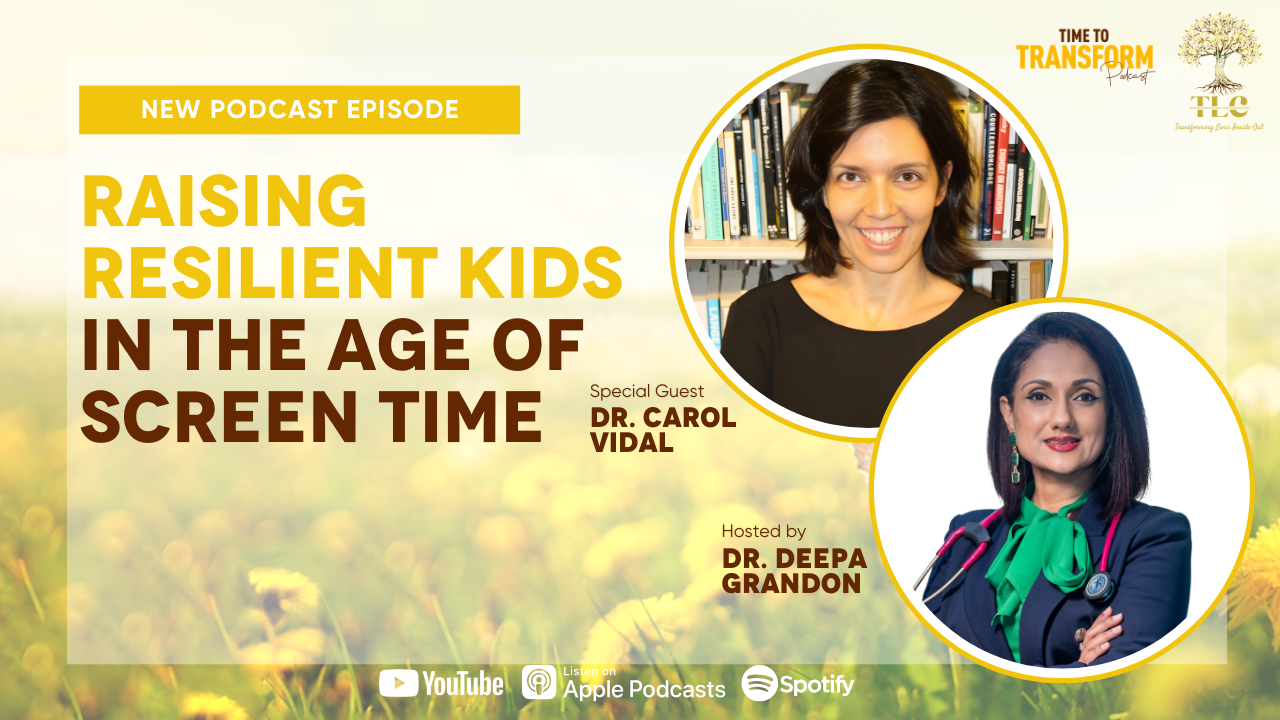
In this episode, I talk with Dr. Carol Vidal, a child and adolescent psychiatrist at Johns Hopkins University. From TikTok “self-diagnoses” to the illusion of online friendships, Dr. Vidal helps us understand what’s really happening inside the minds of today’s youth, and how families can begin to take back control.
Kids are well-supervised in real life, but there isn’t a lot of good supervision on the web. -Dr. Carol Vidal
Things You’ll Learn In This Episode
The hidden cost of “connection”
Social media was designed to keep kids engaged, not safe. What happens when algorithms built for profit start shaping a generation’s mental health?
The new face of attention problems
It’s not always ADHD. Constant overstimulation from screens is raising the brain’s threshold for focus, but can that attention be retrained?
Sleep: the first casualty of late-night scrolling
Blue light isn’t the only culprit. How does nighttime screen use quietly unravel mood, behavior, and emotional stability?
When identity goes digital
Likes and followers have replaced real-world feedback. How does this reshape self-esteem, social development, and the ability to form real relationships?
About my Guest
Dr. Carol Vidal is double-board certified in general and child and adolescent psychiatry. She is an associate professor of psychiatry and behavioral sciences at the Department of Psychiatry and Behavioral Sciences at the Johns Hopkins University (JHU) School of Medicine and holds an adjunct appointment in the Department of Mental Health at the Johns Hopkins Bloomberg School of Public Health. She completed her M.D. and PhD at the Universitat Autònoma de Barcelona and MPH at Drexel University in Philadelphia, and residency in general psychiatry and fellowship in child and adolescent psychiatry at the University of Maryland. She provides clinical services through the JHU Bayview expanded school-based mental health program, evaluating and treating adolescents with behavioral and depressive disorders, and co-directs the SMART (School Mental Health Advice and Response Team) program, funded by the Maryland Department of Health to conduct a suicide prevention program in Baltimore City Schools. Dr. Vidal is the recipient of the NIDA/AACAP K12 (American Academy of Child and Adolescent Psychiatry Physician Scientist Program in Substance Abuse Award) and studies the associations between cannabis use and suicide in adolescents using ecological momentary assessment methods. She has recently published a book called “Status and Social Comparisons Among Adolescents, Popularity in the Age of Social Media.” Her research and clinical interests are around problematic digital media use, addictions, depression, and suicide-related behaviors in adolescents. Find her book on Amazon.
Stay connected with news and updates!
Join our mailing list to receive the latest news and updates from our team.
Don't worry, your information will not be shared.
We hate SPAM. We will never sell your information, for any reason.